

What is My Communication Style?
A manager who cannot read communication styles is flying blind in every difficult conversation. Performance reviews, feedback sessions, conflict resolution, and coaching conversations, all of these break down when style mismatches go unrecognized and unaddressed.
This is not a soft-skills problem. It is a performance problem. When a manager delivers direct feedback to a passive communicator who shuts down under directness, the message is lost before it is heard. When a passive communicator tries to coach an aggressive one, the conversation collapses before it starts.
The GROW® Coaching Model gives managers a flexible conversation structure that works across all four styles, but it only works if you understand the person on the other side of the conversation. That starts here.
Why Communication Styles Matter More Than Most Managers Realize
Communication breakdowns at work are not random. They follow patterns, and most of those patterns are predictable once you understand the four primary workplace communication styles. Research consistently shows that communication problems rank among the top contributors to employee disengagement and turnover. A manager’s ability to recognize a communication style, adapt to it, and respond effectively is not a personality trait. It is a skill, one that can be developed. The most important point before we go into each style: your job as a manager is not to change how your people communicate. It is to understand their style well enough to work within it and help them grow. That distinction separates effective coaches from frustrated managers.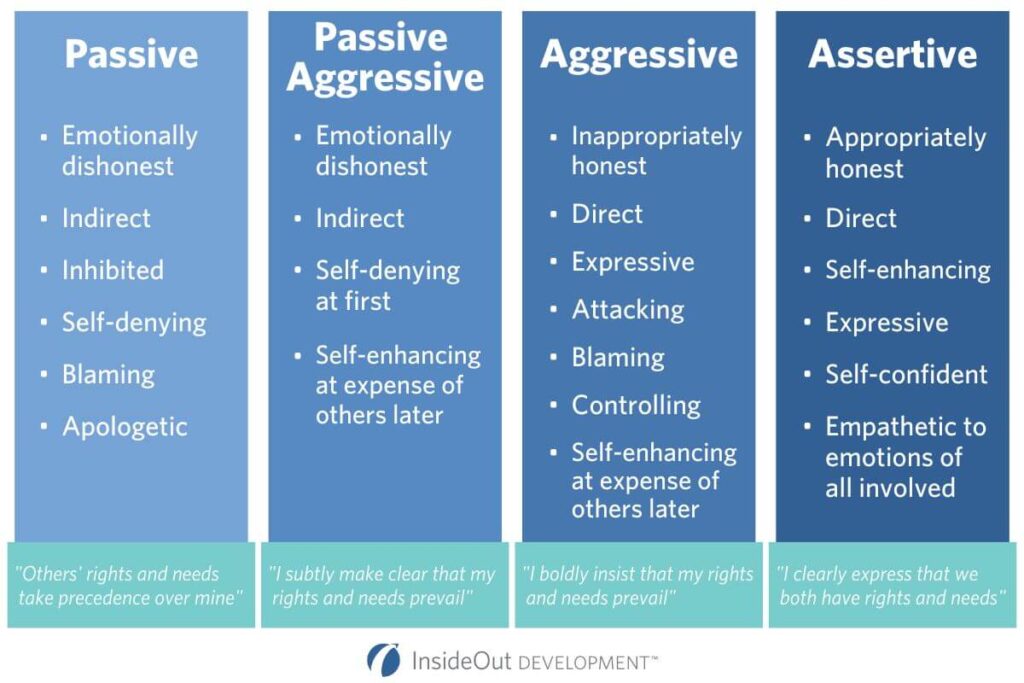
Communication Style 1, Assertive
Assertive communicators are direct, confident, and honest. They say what they mean without filtering for the discomfort it might create. They are clear about their expectations and their limitations.
In the workplace, assertive communicators are often high performers. Their clarity accelerates decisions, their confidence earns respect, and their willingness to name issues prevents small problems from becoming large ones. The friction point arises when assertive communicators work alongside more passive team members, and what reads as normal directness to one person lands as aggression to another.
How Managers and Coaches Work Best With Assertive Communicators
Be direct. Assertive communicators lose respect for hedged, over-softened feedback. If you bury the point to protect their feelings, you have lost the opportunity.
In GROW® coaching conversations, assertive communicators engage naturally with the Goal stage. They are comfortable declaring what they want and where they want to go. Use the Reality stage to help them see the impact of their communication on others: “How do you think that landed with the rest of the team?” A well-placed question is more effective than a lecture.
Do not soften feedback to the point where the message disappears. Assertive communicators can handle directness; they expect it.
Communication Style 2, Passive
Passive communicators avoid conflict. They agree in the room, then act on their actual opinion outside of it. They prioritize harmony over honesty, often at the cost of both.
In the workplace, passive communication creates short-term ease and long-term damage. Teams with passive communicators often appear smooth on the surface;, meetings are calm, disagreements are rare, and everyone nods. Underneath, resentment builds. Concerns that are never voiced do not disappear; they compound.
How Managers and Coaches Work Best With Passive Communicators
Create psychological safety before you expect honesty. Passive communicators have often learned that directness has costs, and speaking up has gotten them burned before. Rebuilding that trust requires consistency: follow through on what you say, do not punish candor, and react calmly when they do open up.
In GROW® coaching conversations, passive communicators will defer to your judgment in the Options stage. They will wait for you to provide the answer rather than generate one themselves. Counter this by explicitly pulling their perspective out: “What do you think could work here?” and then waiting through the silence. The silence is not absence;, it is thinking.
Recognize that passivity often masks unresolved frustration. If you see a pattern of surface agreement with no follow-through, there is something unsaid. Name the pattern without accusation and create space for the real conversation.
Communication Style 3, Aggressive
Aggressive communicators express their thoughts without filtering for impact. They are honest, often strikingly so, but the honesty comes at the expense of relationships and team trust.
In the workplace, aggressive communicators can be extraordinarily effective when the goal requires initiative, resilience, and someone willing to tackle problems directly. They can also create significant friction, particularly with passive or conflict-averse teammates, and they can make psychological safety on a team nearly impossible.
How Managers and Coaches Work Best With Aggressive Communicators
Do not match their energy. Responding to aggression with aggression escalates the situation and undermines your ability to lead. Model assertive communication, direct, calm, and clear.
Acknowledge their competence before addressing behavior. Aggressive communicators often push hardest when they feel their contribution is being dismissed or their credibility is being challenged. Separating “I value your work” from “the way you expressed that in the meeting needs to change” is not a coaching technique;, it is the only sequence that works.
In GROW® coaching conversations, redirect aggressive energy toward the Reality and Options stages. Give them problems to solve, not people to evaluate. “What are two or three ways you could approach this differently?” is more productive than “you need to change how you talk to people.”
Communication Style 4, Passive-Aggressive
Passive-aggressive communicators express frustration or disagreement indirectly. They do not say what they mean;, they communicate discontent through delays, sarcasm, and surface compliance paired with covert resistance.
This is the most difficult communication style to coach because the behavior is covert.
The passive-aggressive communicator in your meeting agreed to the deliverable. They will not deliver it. And when you ask why, they will explain, with perfect reasonableness, why it was not their fault.
How Managers and Coaches Work Best With Passive-Aggressive Communicators
Surface the real issue explicitly during the Reality stage of a GROW® coaching conversation. Name patterns without accusation: “I have noticed a pattern of agreement in our meetings, followed by different outcomes. Can we talk about what is happening between those two points?” The goal is not to trap them, it is to create a conversation that the behavior has been preventing.
Build small wins of open communication before addressing larger conflicts. Passive-aggressive behavior is often a learned response to environments where directness was unsafe or punished. Coaching can shift it, but patience and consistency matter more than confrontation.
Do not accept the behavior as permanent. The passive-aggressive communicator is not a lost cause; they are someone who has not yet found it safe to communicate directly. Your job is to build that safety, consistently over time.