
The Importance of Coaching Conversations for Your Employees
In most cases, when a team member presents a problem, managers default to telling, giving direction, offering advice, or solving it for them. While the intention is to help, over time, this “Outside In” habit creates dependency and limits ownership. When managers consistently provide answers, their people learn to wait for them rather than being empowered to figure it out themselves.
An effective coaching conversation shifts from telling to asking. Rather than positioning the manager as the source of insight, it positions the performer as the source. When leaders coach through conversation, they unlock the existing capacity within their people to solve problems, make decisions, and take action. The difference between a regular conversation and a coaching conversation is structure, intent, and where the thinking happens. In a regular conversation, the manager often does most of the thinking, but in a coaching conversation, the performer does.
A Coaching Conversation is Different from a Typical Manager-Employee Interaction
Coaching conversations are not discussions with measurable impact. In fact, research published in the International Journal of Evidence Based Coaching and Mentoring found that structured coaching interventions improved goal attainment and well-being compared to non-coached groups. Coaching works. The question is how to embed it into everyday leadership.
The key to a successful coaching conversation is using questions rather than advice to drive ownership and accountability. The goal is to surface and reduce interference that blocks performance, enabling a clear, actionable way forward.
In a typical manager-employee interaction, the conversation may drift. It may center on problems without clarity about what success looks like, often ending with vague intentions instead of actionable commitments. By contrast, coaching conversations are intentional and create forward movement.
The Dangers of Not Coaching Through Conversation
When leaders do not coach, predictable patterns emerge. Managers become bottlenecks, and every issue funnels upward for a decision. Instead of building leadership capacity, the organization builds escalation pathways. Because they lack ownership over their performance decisions, employees disengage. When their role is to execute instructions rather than think critically, motivation declines.
Teams will also develop dependency on being told what to do, undermining Decision Velocity®. Without distributed decision-making, responsiveness slows while internal interference like self-doubt, frustration, and lack of clarity goes unaddressed. Over time, that interference compounds and erodes performance.
Performance reviews, therefore, become the only structured feedback moment, making coaching reactive and episodic instead of ongoing and developmental. Finally, organizations lose the ability to scale leadership. Coaching remains siloed at the top rather than embedded across levels.

The Difference Between Telling & Coaching
There are two fundamentally different approaches to performance conversations: telling and coaching.
The Outside In Approach
The Outside In approach is telling, advising, and directing. It assumes that performance gaps are primarily knowledge gaps. If the manager provides the right information, performance will improve. This approach works when three conditions are met:
- The performer genuinely lacks knowledge
- The performer trusts the coach’s expertise
- The performer has the awareness and commitment to act on the advice
The InsideOut Approach™
The InsideOut Approach™ assumes that people often already know what to do.
Coaching through this approach is essential when the performer already knows what to do but is not doing it. The leader’s job in those moments is to draw out insight and commitment. In short, the InsideOut Mindset™ is the belief that every person has untapped potential and an enormous capacity to learn. Leaders who adopt this mindset shift from being problem solvers to being capacity builders.
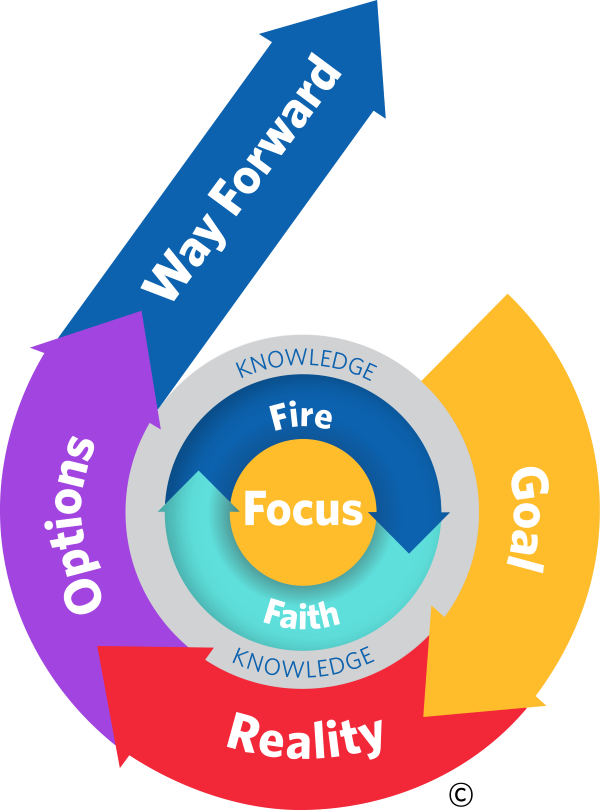
Using the GROW Model to Structure the Conversation
Structure matters, and the GROW Model provides a practical framework that works across industries and leadership levels.
Goal
Start with clarity about what improved performance looks like. Don’t skip this step or default to venting about current problems, and don’t move on to the next step until a goal has been agreed upon. A clear goal anchors attention and sets direction.
Reality
Assess where things stand in relation to the goal. Diagnosing reality without a defined goal creates noise, not clarity. With a goal in place, reality becomes data rather than distraction.
Options
It is easy to fall prey to saying what everyone else in the organization is or isn’t doing, so it’s important to create options that you can control. Generate possibilities before narrowing. Encourage divergent thinking. Aim for at least 20 options before evaluating them. The coach holds back personal ideas until the performer has exhausted theirs. This protects ownership and expands creativity.
Way Forward
End with a specific, actionable next step. Thinking is only valuable if it produces commitment. A clear way forward answers the question of who will do what, by when.
This sequence reduces interference by narrowing focus and building momentum toward action.
Recognize & Reduce Interference in the Coaching Conversation
Internal interference presents in subtle ways, such as excuses, deflection, self-doubt, fixation on what others are not doing, and vague language about next steps. The coach’s role when internal interference is involved is not to dismiss it, but to acknowledge it and redirect focus toward what is controllable.
Common interference patterns include:
- Jumping straight to reality without clarifying the goal
- Narrowing options too early
- Ending with vague ways forward that lack commitment
The GROW Model is designed to counter these tendencies. Each phase disciplines attention, reduces noise, and builds clarity.
How to Build a Coaching Conversation into Everyday Interactions
Coaching conversations do not require formal sessions. The Leader-as-Coach philosophy embeds coaching into daily management. A hallway check-in can begin with a goal, project updates can explore reality against that goal, and a problem-solving moment can expand options before selecting a way forward.
The key is frequency and consistency, not length. Short, focused GROW conversations build Decision Velocity across the organization. When people regularly think through goals, assess reality, generate options, and commit to a way forward, they make better and faster decisions.
Implementing Coaching Conversations for a Stronger Workforce
Effective coaching conversations are not about having all the answers. They’re about asking the right questions in the right sequence. The GROW Model provides leaders with a portable and scalable framework that works from the shop floor to the C-suite. It reduces interference, builds ownership, and strengthens decision-making.
When leaders shift from solving problems to coaching through conversations, they do more than improve individual performance; they build teams that think clearly, decide confidently, and act with greater ownership and speed.