
You may be asking yourself: How does employee engagement affect performance?
Every leadership article, every conference keynote, every consultant deck says the same thing: Engagement matters. You have heard it enough times that it barely registers anymore. The problem is that being told that engagement matters does not explain how it works. Most leaders cannot point to the mechanism that turns an engaged employee into measurable output, so the word remains a slogan rather than a lever they can actually pull.
That gap is worth closing, because the demand is real. Thousands of leaders search for the connection between engagement and results every month, which means the question is not going away. So let us answer it directly.
Employee engagement is the emotional commitment an employee has to the organization and its goals, as Forbes has defined it. When that commitment is present, people direct more effort, attention, and problem-solving toward the work in front of them. That is the whole connection in one sentence: Engaged employees give more of themselves to the job, and that shows up as productivity, quality, and initiative. The rest of this article unpacks how that happens, what sustains it, and what you, as a leader, can do to create the conditions for it.
The Link Between Employee Engagement And Performance
Engagement affects performance through discretionary effort. Every role has a floor, the minimum an employee can do and still meet expectations. Engaged employees work well above that floor because they want to, not because someone is watching. They notice the details others miss, they raise the problem before it becomes a fire, and they bring ideas to work that no job description asked for.
That extra effort is where the numbers come from. Gallup research has repeatedly tied higher engagement to better outcomes across productivity, profitability, and customer results.
Here is the part most engagement programs miss: Engagement is not a perk you install with free snacks and a foosball table. It is a byproduct of two things: better conversations and clearer focus. When people understand what they are aiming at and feel genuinely supported in getting there, commitment follows. That is precisely what the GROW® Model was built to enable: a simple structure for the kind of conversation that helps a person set a goal, see their reality clearly, weigh options, and commit to a way forward. Engagement is what you get when those conversations become normal.
“Engagement is not something you roll out,” explains Alan Fine, co-creator of the GROW Model and bestselling author of You Already Know How to be Great. “It is what happens when people are focused on something that matters and feel like they are part of the conversation. When leaders create that kind of focus, listen well, and help people think rather than simply telling them what to do, engagement becomes a natural byproduct.”
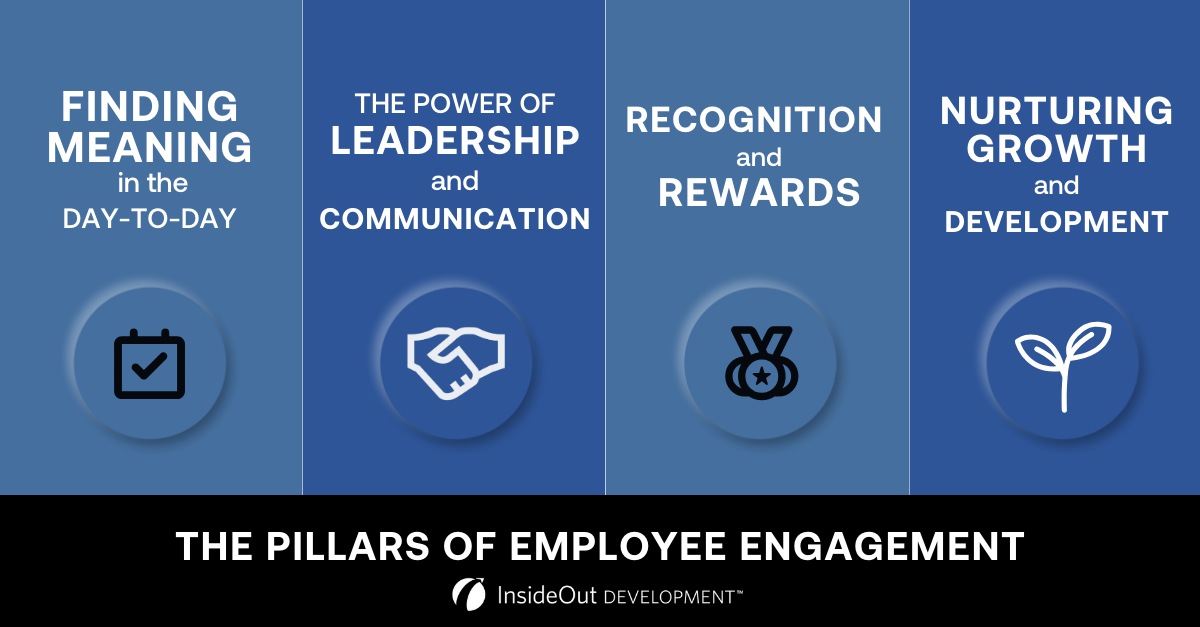
The Four Drivers Of Employee Engagement
Engagement does not appear on its own. Four conditions sustain it, and when one is missing, commitment tends to slip.
Meaningful Work And Purpose
People invest more when the work connects to something they care about. When an employee understands why the task matters and how it fits the larger goal, the work stops feeling like a series of assignments and starts feeling like a contribution. That sense of purpose is one of the most reliable predictors of sustained effort.
Leadership And Open Communication
Employees engage with leaders who talk with them, not at them. Open, honest communication tells people where they stand and gives them room to speak up. When a team knows it will be heard, it brings problems forward early and offers ideas freely. For more on getting these exchanges right, see our post on having a performance conversation with an employee. [Internal link: how to have a performance conversation with an employee → https://insideoutdev.com/blog/how-to-have-tough-conversations-with-employees/]
Growth And Development Opportunities
People stay engaged when they can see a path forward. The chance to build a new skill, take on a stretch assignment, or move toward a bigger role signals that the organization is invested in them. That investment is returned in effort and loyalty.
Recognition And Reward
Effort that goes unnoticed quietly stops. When you acknowledge good work in a specific, timely way, you reinforce the behavior you want more of. Recognition does not have to be expensive to matter; it has to be genuine and seen.
Employee Engagement Versus Motivation
Engagement, motivation, and involvement often get treated as the same thing. They are not.
Engagement is the emotional commitment to the organization and its goals. Motivation is the internal drive to act, the energy behind the effort, what we at InsideOut call Fire. Involvement is simply participation, whether or not any commitment sits behind it. A person can be involved in a project without being engaged in it, and can feel motivated in bursts without staying engaged over time.
On its own, motivation does not reliably convert into performance. Motivation without focus scatters. What produces results is engagement paired with clear focus, effort pointed at the right goal, sustained over time. That is the combination worth building for.
The Benefits Of Employee Engagement On Performance
When engagement is high, the effects reach well beyond individual output.
Stronger Retention And Lower Turnover
Engaged employees are invested in the long term, not just clocking in and out. That commitment lifts retention and cuts turnover, which spares the organization the real cost of constantly hiring and retraining. People who feel connected and valued tend to stay.
Better Team Collaboration
Engaged people work together more easily. They share information, cover for one another, and combine their strengths instead of guarding their turf. The result is a team that produces more than its members would separately.
Higher Customer Satisfaction And Loyalty
Engagement is visible to customers. An employee who cares about the work treats the customer with more attention and follow-through, and that experience builds the kind of loyalty that keeps people coming back.
Stronger Organizational Reputation
Engaged employees speak well of where they work to candidates, partners, and customers. Their commitment shapes how the organization is perceived, which strengthens the brand from the inside out.
The Role Of Leadership In Engagement
Your influence sets the conditions for engagement, for better or worse. The most useful things a leader can do are consistent: keep communication open and honest, give people the autonomy to do their work, offer regular and specific feedback, and build a workplace where support is the default. Leaders who operate this way create engagement almost as a side effect. To go deeper on this shift from manager to coach, see our Leader as Coach resource.
How To Measure Employee Engagement
A good engagement measure looks at behavior, not just mood. Satisfaction scores tell you whether people are content. Engagement measures tell you whether they are committed enough to act, which is what actually predicts performance. The best measures track behavioral signals such as discretionary effort, intent to stay, and active participation.
A few methods work well together:
- Engagement surveys and shorter pulse checks that ask about commitment and clarity, not just happiness
- Key indicators such as discretionary effort, retention intent, and how readily people contribute
- A plan to act on what the data shows, because a survey that leads to no visible change erodes the trust it was meant to measure
Once you can clearly see engagement, you can connect it to output. For the performance side of that picture, read our post on how to track employee performance.
Overcoming Challenges To Employee Engagement
Certain obstacles show up again and again. Each one has a coaching-oriented fix.
Unclear Communication
When people are unsure what is expected or where they stand, engagement drops. Regular one-on-ones, honest feedback, and structured check-ins close the gap. The point is not more meetings; it is clearer ones.
Limited Growth Opportunities
When people cannot see a way forward, they disengage. A culture rooted in coaching and continued growth tends to sustain engagement on its own. Training, mentorship, and stretch assignments give people somewhere to go. For more on building that environment, see our Coaching Culture page.
Poor Work-Life Balance
People who feel their time and well-being are respected stay longer and give more. Policies that support balance, flexible hours, realistic workloads, and room to work remotely where it fits signal that the organization values the person, not just the output.
Focus On Your Employees And Performance Will Follow
Here is the short version of everything above: Employee engagement affects performance through effort, focus, and better conversations, and you control the conditions that produce all three. When you communicate clearly, create room to grow, recognize good work, and respect people’s time, engagement rises, and performance follows it.
None of this requires a grand initiative. It requires the leader to change the quality of the conversations happening every day. If you want a structure for those conversations, the GROW® Model is a practical place to start.